December 14, 2025
Favorite Children’s Books of the Year
(From Our 2025 Newsletter Book Selections)
By Leonard Chan
This is the fifth edition of our year-end review of children’s picture books we featured in our newsletters during the past year.
The guidelines are the same as in our past years. You can read the guidelines by clicking on the following link: favorite children’s picture book guidelines
This year, I was able to review 56 out of 67 books that were within the guidelines. Everything I said at the beginning of last year’s article still holds true and I invite you to reread that article and all the past favorite articles (2024, 2023 , 2022, and 2021).
As in the prior two years, I’ve created two lists. The first list of books will be original stories and the second will be books based on real people and or events.
Original Stories
More Information
Or to Order
(Tie for number 5)
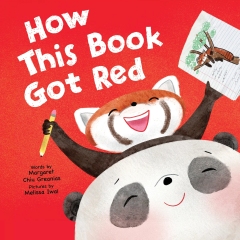
How This Book Got Red
By Margaret Chiu Greanias,
Illustrated by Melissa Iwai
In a time when the practice of inclusion is being questioned and ended in some quarters, it is refreshing to see a book that so prominently shows the meaning and importance of the word.
In this story, two friends, a giant panda named Gee, and a red panda named Red, are reading a book about pandas and find out that the book does not include anything about red pandas. So Red decides to write her own book on the subject. Is there interest in such a book? Will she get discouraged and give up?
I love it when a children’s book can sneak in important concepts such as this into their story.
(For More Information or to Order)
More Information
Or to Order
(Tie for number 5)
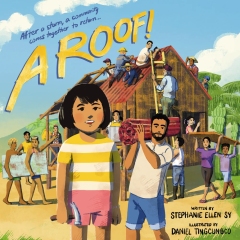
A Roof!
By Stephanie Ellen Sy
(Author),
Daniel Tingcungco (Illustrated by)
Just like “How This Book Got Red,” “A Roof!” highlights an important concept – in this case it’s the power of a community that comes together after a disaster.
A girl and her father enlist the help of the community to find the owner of a roof that blew on to their property after a storm. When they find the owner they also help to rebuild that owner’s house.
At the end of the story, the girl expresses her desire to help others. So should we all.
(For More Information or to Order)
More Information
Or to Order
(Number 4)
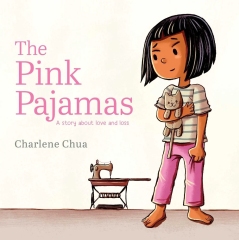
The Pink Pajamas: A story about love and loss
By Charlene Chua
(Author)
,
Charlene Chua
(Illustrated by)
In this story, a girl has a favorite aunt that makes her clothes and other things such as pajamas.
This is a simple story about family members that pass away (in this case, the favorite aunt) and the things they leave behind for us. The loss of loved ones is a difficult thing for anyone at any age, but it’s good that a children’s book can approach this topic so well.
(For More Information or to Order)
More Information
Or to Order
(Number 3)
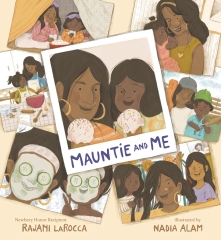
Mauntie and Me
By Rajani LaRocca
(Author)
,
Nadia Alam
(Illustrated by)
Interestingly enough there were two books about aunts that I reviewed this year and both of them made it to my favorites list.
Mauntie is the nickname that a girl gives to her aunt which is a contraction of the words “my auntie.”
The story kind of reminded me of my big extended family of cousins, aunts, and uncles. We tended to bond closer to some than others. In this story, the main character learns that her favorite aunt also happens to be one of her cousin’s favorite aunts too. Is there enough attention and love to go around to both nieces and between the cousins? Sure.
When I thought about this book, I was reminded of memorial services where you learn that the departed had so many different lives and loved ones that you didn’t know about. We only see and are a part of a portion of anyone’s life and it’s an interesting lesson to learn that love can be shared.
(For More Information or to Order)
More Information
Or to Order
(Number 2)
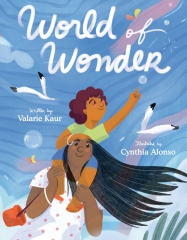
World of Wonder
By Valarie Kaur
(Author)
,
Cynthia Alonso
(Illustrated by)
In this story a boy goes around wondering about the world around him – both the good things and even the bad.
This is another simple story, with the message being that wonder is the start of understanding, empathy, and love.
The author, Valerie Kaur, is a civil rights activist and is the head of the Revolutionary Love Project. She is also the author of the non-children’s book “See No Stranger.” You can read about her from the book’s back notes and learn why she believes that wonder is the heart of love.
(For More Information or to Order)
More Information
Or to Order
(Number 1)
Perfect
Waka T. Brown
(Author),
Yuko Jones
(Illustrated by)
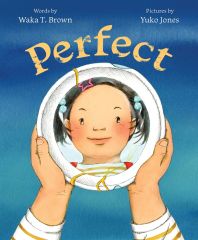
Isn’t it perfect that my favorite original children’s picture book should be titled “Perfect”? But the whole point of the story is that things aren’t always perfect.
When I first looked at the cover of this book, I was kind of curious about the image of a seemingly non-perfect girl being so prominently portrayed under the title. In the image we are really looking at the reflection of the girl as she looks into her filled broken cup.
At the beginning, we learn that the girl likes everything to be perfect. When she accidentally breaks a perfect cup given to her by her grandmother, she hopes that the grandmother can get her an unbroken one just like it. When the grandmother returns with the repaired broken cup, fixed using the Japanese crafting method called Kintsugi, at first the girl is very disappointed. Then she learns that some things are really better when they aren’t perfect.
Part of the philosophy that goes with Kintsugi is the embracing of flaws or imperfections. As the grandmother says in the story, “nothing is perfect.” This is such a valuable lesson.
(For More Information or to Order)
More Information
Or to Order
(Number 5)
Wat Kept Playing: The Inspiring Story of Wataru Misaka and His Rise to the NBA
By Emily Inouye Huey
(Author)
,
Kaye Kang
(Illustrated by)
In recent years there have been at least three children’s picture books written about Wataru Misaka. Two of them were featured this year in our newsletters. Both books are good, but I thought that this one worked a little better.
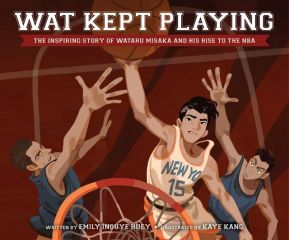
In the case of children’s books, sometime less text and details is better. “Wat Kept Playing” is simply written and a very well illustrated children’s book about the first non-white player to play in the league that would eventually become the NBA.
In a time during and after World War II, it was miraculous that Wat Misaka was able to turn crowds that were hateful of Japanese into fans of his play.
(For More Information or to Order)
More Information
Or to Order
(Number 4)
A Line Can Go Anywhere: The Brilliant, Resilient Life of Artist Ruth Asawa
By Caroline McAlister
(Author),
Jamie Green
(Illustrated by)
Like Wat Misaka, there have been a number of children’s picture books about the artist Ruth Asawa. Perhaps what has fueled the interest in her are some recent exhibitions of Asawa’s works. I was fortunate to have gone to one at the San Francisco Museum of Modern Art this year.
Having seen the exhibit and read this book, I found it interesting that the book covered some aspects of her life that I did not learn from the exhibition. “A Line Can Go Anywhere” was pretty thorough in covering Asawa’s early life, including her World War II experience in internment camps.
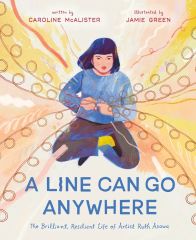
I also found the illustrations to be excellent, which is fitting for a book about an artist. My one criticism is that the front cover of the book was not as good as the illustrations within it. So if you see this book, please have a look inside.
(For More Information or to Order)
More Information
Or to Order
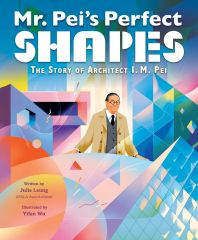
(Number 3)
Mr. Pei’s Perfect Shapes: The Story of Architect I. M. Pei
By Julie Leung
(Author),
Yifan Wu
(Illustrated by)
This is another book about a famous artist, architect Ioeh Ming Pei or I. M. Pei. Like most biographies done in children’s picture book format, we get lots of interesting information about the subject. We learn of his early years in China, his education, and then his many works, including the Kennedy Library, the Bank of China skyscraper in Hong Kong, a wing to the National Gallery of Art in Washington DC, the famed new section to the Louvre Museum in Paris, and more.
As in the book about Ruth Asawa, the illustrations in this one were also excellent. Among the books I reviewed this year, the illustrations for this book are among the best, and is one of the reasons why I rated this book so highly.
(For More Information or to Order)
More Information
Or to Order
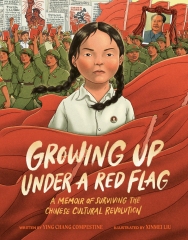
(Number 2)
Growing Up Under a Red Flag: A Memoir of Surviving the Chinese Cultural Revolution
By Ying Chang Compestine
(Author),
Xinmei Liu
(Illustrated by)
The author of this book also wrote another book that I reviewed this year, “Ra Pu Zel and the Stinky Tofu.” You couldn’t get two books that were more different. “Ra Pu Zel” is a folktale whereas “Growing Up Under a Red Flag” is so real you can imagine the horrors of having lived through the 1960s and early 70s in China.
The illustrations are done in a style reminiscent of the art style of Communist China during the period portrayed in the book.
My one concern was that the subject matter might be too heavy for children to read, but it should be something that they learn – of how totalitarian governments treat their citizens and to be vigilant and empathetic for when it happens somewhere today.
(For More Information or to Order)
More Information
Or to Order
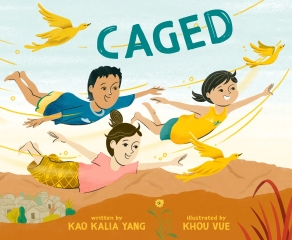
(Number 1)
Caged
By Kao Kalia Yang
(Author),
Khou Vue
(Illustrated by)
This is one of the books where I was not sure whether to classify as an original story or in this category. It definitely is a work based on the author’s real experience, so I placed it here. However, this book would probably be my number one pick in either category.
This is author Kao Kalia Yang’s third book to make my favorites list in five years and deservedly so. Kao Kalia Yang is a great writer. There are three more children’s books of hers that I have not yet read (two of which are coming out next February). So don’t be surprised if you should see more of her books again in a future year-end review.
This story is about a six-year-old girl living in a refugee camp – the same age that Kao was when she left a refugee camp in Thailand. Kao Yang states in her notes that she got the inspiration for the book after her daughter saw the images of children being locked up in detention camps at the US border with Mexico during the first Trump administration. She asked her mom, “…are those kids in cages?” Kao knowingly answered yes.
Kao Kalia Yang’s story reminds me of some of the stories I’ve read about Japanese Americans’ experiences in US internment camps during World War II. It’s sad to think that children and adults are still being locked away in camps today merely for wanting to live free from danger and hardships.
This book is a reminder of why we should not turn our backs on these people and have some compassion and empathy for all those in need and yearning to be free.
(For More Information or to Order)
Copyright © 2025 by AACP, Inc.