May 30, 2026
Yick Wo
A Forgotten but Vital Legal Case
Recently, San Francisco held a commemoration ceremony in the corner of a parking lot, with city leaders including the City Attorney and Supervisors showing up to the event. (source 1) This parking lot was once home to one of the most important—yet largely unknown—legal cases that helped establish the foundation of the Civil Rights movement in the 1960s. Yick Wo v. Hopkins, decided by the Supreme Court on May 10, 1886, has since been cited more than 150 times in later Supreme Court cases and laid the groundwork for landmark rulings such as Brown v. Board of Education. (2)
This case grew out of the social and economic conditions created during the Gold Rush era, when hundreds of thousands of miners flocked to California. With that rise in population came a demand for clean laundry. Because most miners lacked the time or ability to wash their own clothes, Chinese immigrants stepped in to fill the gap, ultimately dominating the laundry business.
Their success, however, soon made them a target. Even though the Chinese were initially welcomed, they were later blamed for stealing jobs, as they were perceived as willing to work for long hours with little pay. (3) It was in this broader anti-immigrant environment that Congress passed the notorious Chinese Exclusion Act, the first law to prevent immigration of a specific ethnic group. In San Francisco specifically, more than a dozen laws were passed against laundries with the goal of “restrict[ing]... the keeping and carrying on of laundries by the Chinese to a certain designated portion of this city and county.” (4)
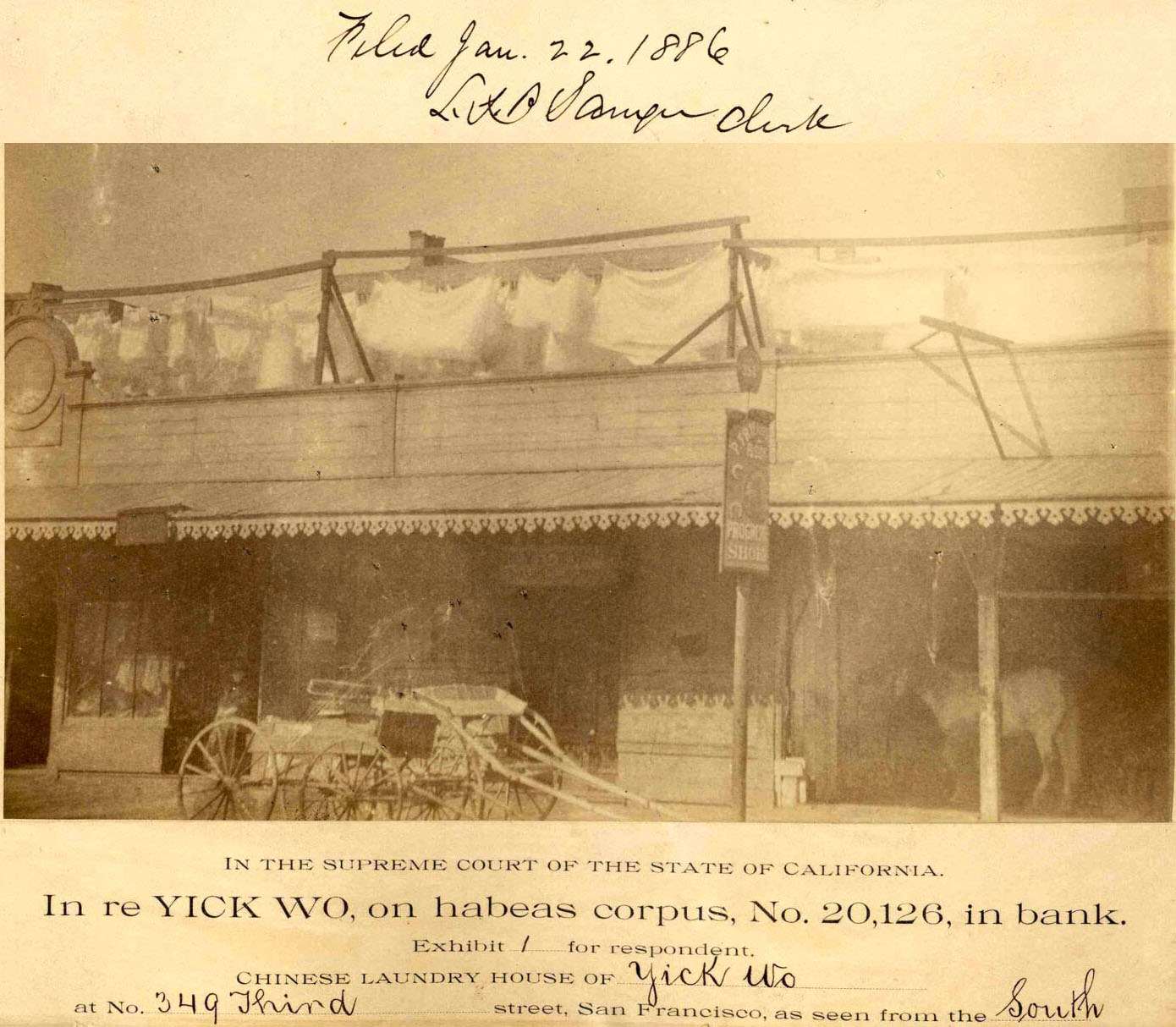
One particularly burdensome rule was Order No. 1569, which required all laundries that operated in a wooden building to obtain a permit to operate. While the stated reason was to reduce fire hazards, one could clearly see the discriminatory intent: out of the 320 laundries that applied, 220 were rejected—all but one of which was owned by a Chinese immigrant. (5) However, one immigrant named Lee Yick, who had come to the US in 1861, defied the law and continued operating his laundry, called Yick Wo. When he refused to pay the $10 fine for violating the Order, Yick was jailed.(6)
In response, Yick’s lawyers petitioned for a writ of habeas corpus, seeking relief from imprisonment. The California Supreme Court initially ruled that the ordinance was non-discriminatory because it did not explicitly mention race. However, Yick’s lawyers pressed the case further, and it eventually reached the Supreme Court. In a unanimous decision, the Supreme Court reversed the lower court’s decision, holding that even though the law was not explicitly discriminatory, “if it is applied and administered by public authority with an evil eye and an unequal hand,” it was still “within the prohibition of the constitution.” (7) In other words, even if a law is neutral on face, if it is applied to hurt a specific group, it is still unconstitutional under the 14th Amendment.
This principle has proven to be tremendously important. While its immediate impact in the 1800s was limited—for example, with the notorious Plessy v. Ferguson following just a decade later—Yick Wo laid the groundwork for future Supreme Court decisions regarding segregation, voting rights, disability rights, and even gay marriage. (8)
However, the legacy of Yick Wo is increasingly being challenged today. Just over a year ago, the Trump administration signed an executive order titled “Restoring Equality of Opportunity and Meritocracy” that targeted the legal doctrine known as “disparate impact.” (9) Under disparate impact, actions that are not explicitly discriminatory but have discriminatory consequences are considered unconstitutional—the very idea contained in the Yick Wo decision. By ordering federal agencies not to pursue disparate impact claims, the Trump administration undermined the legal precedent set by Yick Wo over a century ago (although other cases also set this precedent, including Griggs v. Duke Power Company in 1971). (10) The Supreme Court, too, recently ruled in a voting rights case that plaintiffs challenging racial discrimination under the 1965 Voting Rights Act must prove the intent to discriminate. This standard makes such claims significantly harder to bring and has already contributed to a wave of redistricting efforts widely criticized as racially motivated. (11)(5)
Lee Yick’s laundry shop is now long gone, with its former site being occupied by a parking lot, but the fight the case helped begin is not over. Even as courts and administrations attempt to redefine the boundaries of equality under the law, the principle at the core of Yick Wo—that discrimination in practice is the same as discrimination in law—remains as necessary as ever to defend.
Sources
(2) https://landmarkcases.c-span.org/Case/18/Yick-Wo-v.-Hopkins
(3) (4) (8) https://hoodline.com/2015/08/yick-wo-and-the-san-francisco-laundry-litigation-of-the-late-1800s/
(6) https://apiabiography.sfsu.edu/yick-wo
(7) https://www.law.cornell.edu/supremecourt/text/118/356
(10) https://www.americanprogress.org/article/the-truth-about-disparate-impact-and-equity/
(11) https://www.supremecourt.gov/opinions/25pdf/24-109_21o3.pdf
Copyright © 2026 by AACP, Inc.