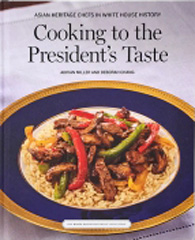
CT/LC: Both of you have extensive backgrounds. You are both alumni of Stanford and were both lawyers. Adrian, you even had a period where you served in the Clinton administration at the White House. But you also both had an interest in food and cooking. Very briefly, tell us about your journey to writing this book. When did you first start to think about doing this book and how did you get interested in writing it? Specifically, tell us about Chef Lee Ping Quan. He seems to be the key to your book. Who was he and tell us about the book that he wrote? How did your backgrounds help you in writing this book?
Adrian Miller (AM): I became a food writer quite by accident. After working in the Clinton White House, I was actively trying to move back to my hometown of Denver, Colorado to continue my political career. The job market was slow, so I was in Washington, D.C. much longer than I expected. I fell into a dreadful pattern of watching a lot of daytime television. I’m embarrassed to admit the shows that I watched extensively. In the depth of my depravity, I said to myself, “I should read something.” I went to a local bookstore and Southern Food: At Home, On the Road, In History by John Egerton caught my eye. In that book was the following sentence that piqued my curiosity and changed my life: “[T]he comprehensive history of black achievement in American cookery still waits to be written.” The book was fourteen years old when I read it. I emailed Mr. Egerton, told him how much I loved his book, and asked if he still felt that his challenge was still true. He replied that it was only met in part, that there was room for additional voices, and why not mine. With his encouragement, I launched my food writing career.
While researching African American chefs in the extensive cookbook collection at the University of Denver’s Special Collections Department, I came across an extraordinary book published in 1939: To a President's Taste: Being the reminiscences and recipes of Lee Ping Quan, ex-president's steward on the presidential yacht, U.S.S. Mayflower, as told to Jim Miller. I nearly fell out of my chair. Part memoir, part cookbook, it was the most comprehensive book about a presidential chef up to that point. Quan served as the presidential yacht chef for Presidents Warren Harding, Calvin Coolidge, and Herbert Hoover. After his presidential cooking stint, he started several high-end restaurants in New York and Maine, but they all failed due to the Great Depression.
Deborah Chang (DC): I did an “odd”, non-traditional, career pivot in the early 2000s. I left a big law firm position and the law completely to try something new. It was the beginning of a lifelong journey of self-growth and learning. I decided on culinary school not because I hadn’t necessarily always wanted to be a chef, but because it seemed fun and I could learn some practical skills. If I had extensively researched what it was like to actually be a chef, I have to confess, I’m not sure I would have done it! Strangely, my lawyer and general “being a good student” skills like working hard, paying attention, asking questions, served me well in culinary school. I discovered that I like to learn new things, made life-long friendships and I was making delicious food at the same time!
So when Adrian and I happened to have dinner with a mutual friend of ours, the stars aligned as he was looking for someone to do the cooking part of the project. ..